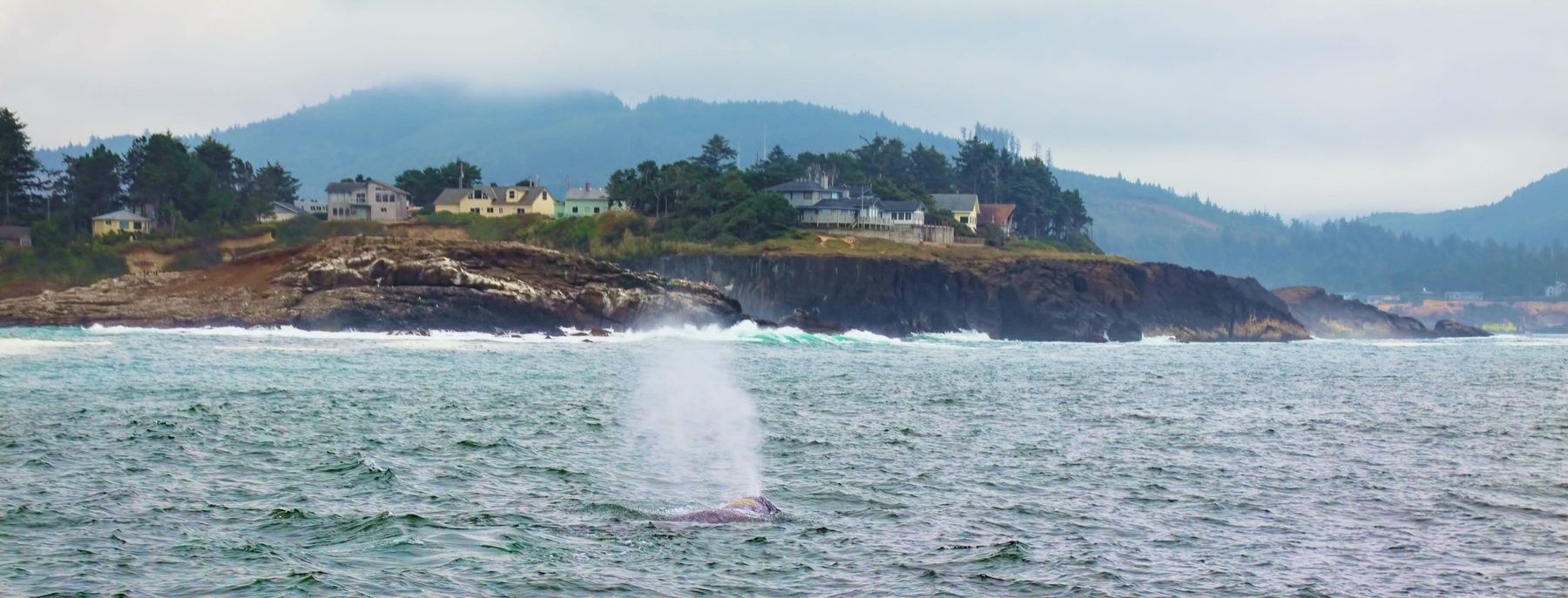
Around 30 gray whales an hour pass this coast between Christmas and New Year. Here is when, which headland to stand on, how to actually spot one — and why you can do it from the couch without going anywhere.
Updated November 9, 2026
Next: Winter Whale Watch Week, December 27–31, 2026 — 40 days away
Check the swell and wind first — flat water makes spotting far easier →
Twice a year the entire eastern North Pacific population of gray whales swims past this stretch of coast. They go south in winter, from the Arctic to the calving lagoons in Baja, and north again in spring with calves alongside. The route runs close enough to shore that you can watch the whole thing from a headland with a flask of coffee.
The southbound run is the better one to plan around. It is faster, more concentrated, and it peaks almost exactly over the holidays — which is also when a rental on this coast is at its quietest and the light is at its lowest and best.
When to go
The southbound migration runs from about mid-December through January, and the peak falls between Christmas and New Year, when roughly thirty whales an hour pass a given point on the coast. The northbound migration is spread much thinner — around six an hour — but runs from late March well into June, and the spring trip brings mothers with calves travelling slowly and close in.
The two organised weeks, 2026–2027
- Winter Whale Watch Week
- December 27–31, 2026
- Spring Whale Watch Week
- March 20–28, 2027
- Southbound migration
- Mid-December through January
- Southbound peak
- Christmas to New Year, about 30 whales an hour
- Northbound migration
- Late March into June, about 6 an hour
- Best time of day
- Morning, before the afternoon wind gets up
You do not have to come during an organised week. The whales do not know about it. What the week gives you is trained volunteers at staffed viewpoints along the coast who will point and tell you what you are looking at, which is genuinely useful the first time. In recent years they have been out from 10am to 1pm, and the Whale Watching Center in Depoe Bay has opened longer hours through the week.
Check the staffed site list before you drive anywhere specific
Oregon State Parks publishes a map of which viewpoints are staffed a few weeks before each week, and the list changes from year to year. Cape Meares Lighthouse has been on it recently. Do not drive an hour on the strength of any guide, this one included — check the official map first.
You can do this from the sofa
Worth saying early, because it is the part people do not expect. The house looks west down over Daley Lake, across Camp Winema on the far shore, and out to the open Pacific beyond it. The migration runs through that last band of water. With a pair of binoculars you can sit inside, warm, and watch the blows go south.
It is a distance view rather than a close one — you are watching spouts rather than counting barnacles — but it means a December morning with rain on the glass is not a wasted one. Put the binoculars on the windowsill when you arrive. The headlands below are better for a proper look, and this is the one you will actually do every day.
Leave the binoculars by the window
Whales surface three or four times and then dive for several minutes. That rhythm rewards someone glancing up from a book every so often far more than it rewards twenty focused minutes in the cold — which is the real argument for watching from indoors.
Where to watch, if you want to get closer
Height is what matters. Gray whales surface to breathe three or four times in a row and then dive for several minutes, so you are looking for a brief white puff of spray against dark water — easy from fifty feet up, nearly impossible from the beach. Every good spot on this coast is a headland.
Cape Kiwanda — 10 minutes north
The closest real option. The sandstone headland north of the dory beach gives you elevation and a clear southward view, and you can be there in ten minutes. Walk up the dune rather than out along the cliff edge.
Cape Lookout — roughly half an hour north
The best land-based whale watching on this part of the coast, and it asks something of you: the trail runs two and a half miles out along the spine of the cape to a viewpoint at the tip, about four hundred feet above the water and a mile and a half out to sea. You are standing in the middle of the migration lane. Allow half a day, take the mud seriously, and go on a calm morning.
Cascade Head — 15 minutes south
The grassland on the shoulder of the headland is high, open and faces straight out to sea. The lower trail from Knight Park is open year round, which matters here — the upper trail is shut from January 1 and that takes out most of the winter season.
Cape Meares — the far end of the Three Capes Loop
Further than the rest, but the lighthouse headland is a long-standing whale watching site and has been staffed during recent weeks. Worth it if you are making a day of the loop rather than a single stop.
How to actually spot one
- Look for the blow, not the whale. A gray whale exhales a bushy spout six to ten feet high that hangs for a second or two against dark water. That is what you see first, almost every time.
- Scan slowly with your eyes, then confirm with binoculars. Sweeping the horizon through binoculars is the commonest mistake — the field of view is too narrow to find anything.
- Watch one patch of water and be patient. They surface three or four times in a row, then dive for three to six minutes and come up further along.
- Go in the morning. Afternoon wind puts whitecaps on the water and a blow and a whitecap look identical at distance.
- Calm, overcast days beat bright ones. Glare off the water is worse than cloud.
- Give it an hour. At thirty an hour in late December you will see something; at six an hour in April you need to settle in.
Stay behind the fencing
The sandstone at Cape Kiwanda is undercut and crumbles without warning, and people have been killed going past the fences for a better view. Every headland on this coast is worth looking at from the legal side. Whales are patient; the cliff is not.
The ones that never leave
A couple of hundred gray whales skip the Arctic entirely and spend the summer and autumn feeding along the Oregon coast instead. They are known as the resident whales, and they are the reason you can sometimes see a blow off this coast in August when the migration is thousands of miles away. If you are here outside the migration windows, it is still worth a look.
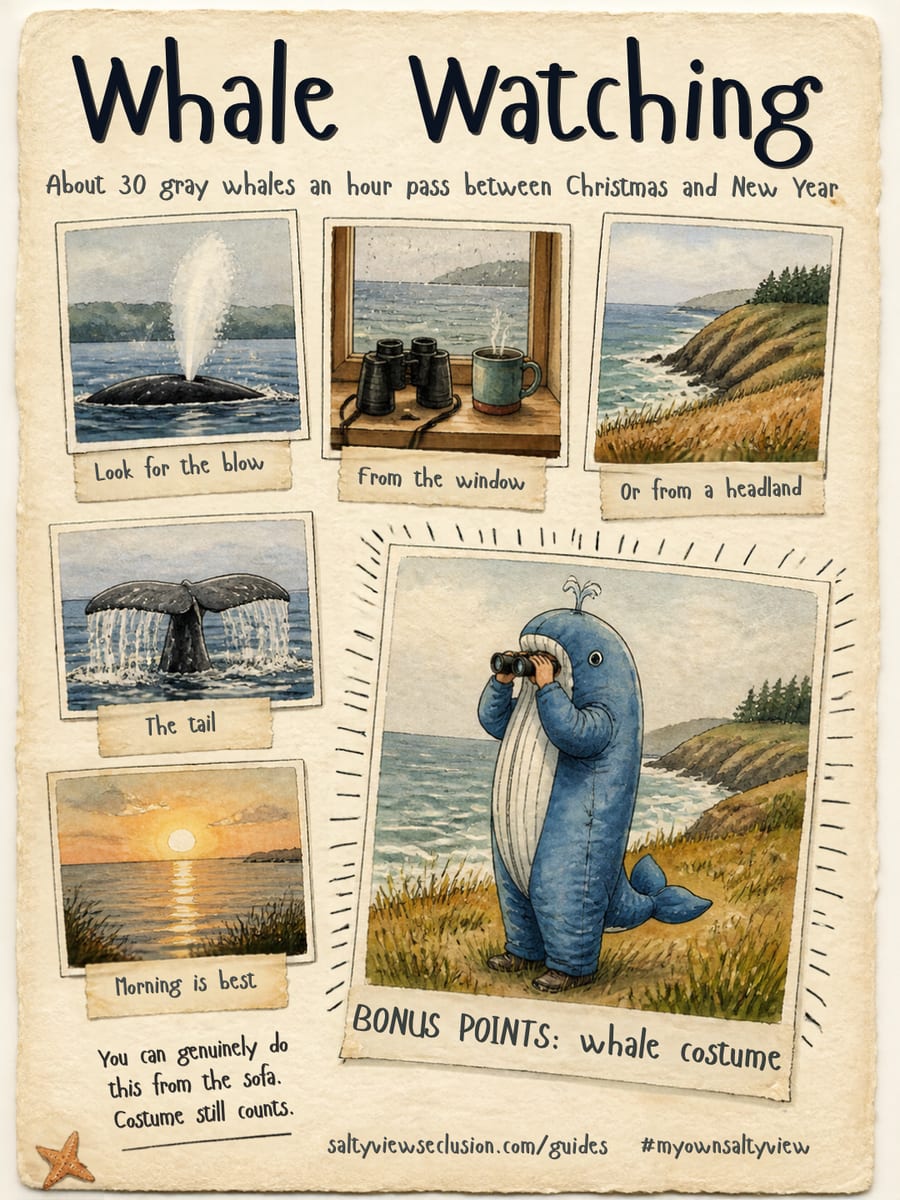
Save it, screenshot it, take it with you. If you find one of these, tag it #myownsaltyview and we will see it.
@saltyviewseclusionCommon questions
When is Whale Watch Week on the Oregon coast in 2026?
Winter Whale Watch Week runs December 27–31, 2026. Spring Whale Watch Week runs March 20–28, 2027. Both are organised by Oregon State Parks, with trained volunteers at staffed viewpoints along the coast.
What is the best time to see gray whales in Oregon?
The southbound migration peaks between Christmas and New Year, when roughly thirty whales an hour pass a given point. That is the densest it gets all year. The northbound run from late March into June is thinner at about six an hour, but the whales travel closer to shore and mothers bring calves.
Where can you see whales near Pacific City and Neskowin?
Cape Kiwanda is the closest, ten minutes north, and gives you height above the dory beach. Cape Lookout has the best land-based viewpoint on this part of the coast, at the end of a two-and-a-half-mile trail along the headland. Cascade Head, fifteen minutes south, is high and open and its lower trail stays open through winter.
Can you see whales from the house at Salty Views?
Yes, with binoculars. The house looks west over Daley Lake and Camp Winema to the open ocean beyond, and the migration runs through that outer band of water. It is a distance view — you are watching the spouts rather than the whales — but you can do it from indoors with a coffee, which on a wet December morning is the whole point.
Can you see whales from the beach?
Rarely, and not reliably. You are looking for a spout of spray against dark water, which needs height to pick out. Everything good on this coast is a headland — from sea level you will mostly see sea.
Do you need binoculars for whale watching?
They help, but find the whale with your eyes first and then raise them. The commonest mistake is sweeping the horizon through binoculars, where the field of view is far too narrow to catch a spout that lasts a couple of seconds.
Are there whales off the Oregon coast in summer?
Yes. A couple of hundred gray whales, known as the resident whales, skip the Arctic migration and feed along the Oregon coast through summer and autumn. They are the reason you can see a blow here in August.